Two decades of measuring what matters
ShanghaiRanking Consultancy is a world leading expert in higher education competitiveness. Its flagship ranking, the
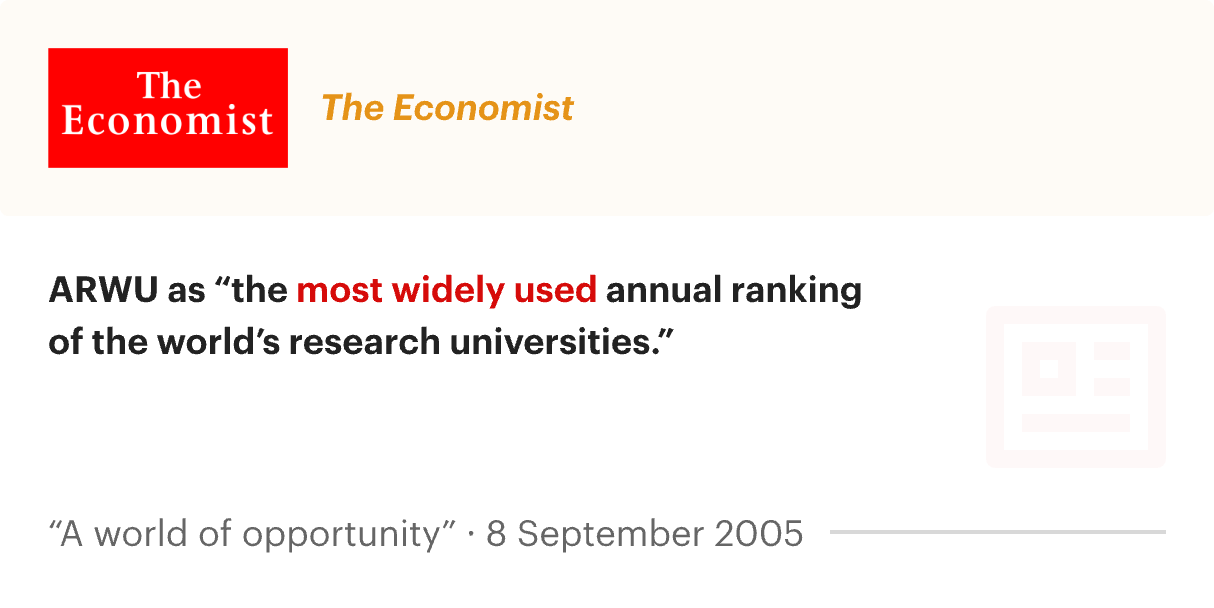
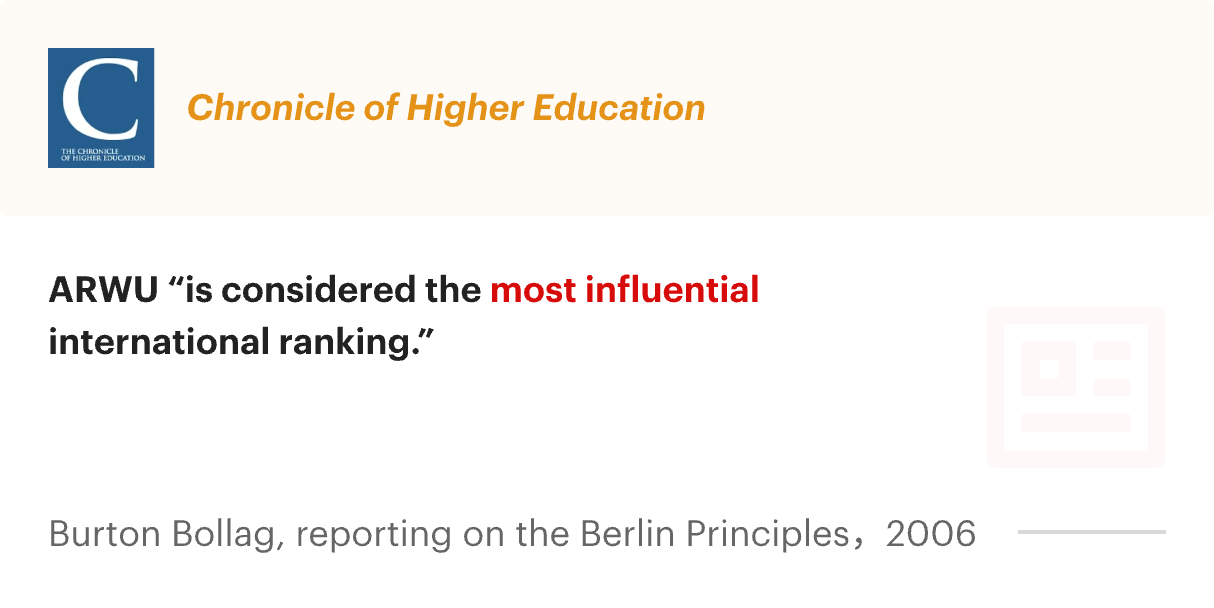
Academic Ranking of World Universities (ARWU), was first published in 2003 and has since become one of the most
influential and authoritative university rankings in the world. ShanghaiRanking also publishes a suite of annual
rankings — including the Global Ranking of Academic Subjects (GRAS), Best Chinese Universities Ranking (BCUR), Best
Chinese Subjects Ranking (BCSR), Best Chinese Majors Ranking (BCMR), and Best Chinese Vocational Colleges Ranking
(BCVCR) — all recognized by government agencies, scholars, universities, and leading media worldwide for their
objective, indicator-driven methodology.
2003
ARWU is born
The Academic Ranking of World Universities (ARWU) is first published by the Center for World-Class Universities at Shanghai Jiao Tong University — part of a national research effort to benchmark China's universities against global standards, and the world's first global university ranking with a fully transparent, indicator-based methodology.
2009
ShanghaiRanking is founded
ShanghaiRanking Consultancy is established, taking over ARWU's publication and copyright from Shanghai Jiao Tong University and beginning the expansion into a comprehensive ranking and analytics organization.
World subjects ranking debuts
The first global ranking at the individual academic subject level is published, giving institutions granular performance insights across subjects for the first time.
2015
Best Chinese Universities Ranking (BCUR) debuts
The inaugural Best Chinese Universities Ranking (BCUR) is released, marking ShanghaiRanking's expansion into domestic higher education evaluation with a dedicated, indicator-based framework for Chinese institutions.
2016
GRAS is formally named
The subject rankings are formally named the Global Ranking of Academic Subjects (GRAS), bringing subject-level evaluation to institutions worldwide across an expanding range of academic fields.
2017
Best Chinese Subjects Ranking (BCSR) debuts
A dedicated, indicator-based evaluation framework for Chinese universities at the subject level is introduced, covering hundreds of institutions and thousands of subject entries.
2021
Best Chinese Majors Ranking (BCMR) debuts
For the first time, individual undergraduate majors across Chinese universities are evaluated and ranked, offering prospective students and institutions granular, program-level performance data.
2023
Best Chinese Vocational Colleges Ranking (BCVCR) debuts
The ranking framework extends to vocational education, covering higher vocational colleges across China and completing the most comprehensive evaluation framework for Chinese higher education — from research universities to vocational colleges.
Today
Trusted by universities worldwide
ShanghaiRanking now serves hundreds of universities, government agencies, and international organizations worldwide. Governments in the United Kingdom, France, Japan, the Netherlands, and Russia have adopted ARWU as a benchmark in national talent recruitment and scholarship policies; world-class universities such as the University of Manchester and the University of Western Australia have set ARWU ranking improvement as an explicit goal in their strategic plans.
Global rankings, objective indicators, open methodology
Academic Ranking of World Universities (ARWU)
The Academic Ranking of World Universities (ARWU) is recognized as the precursor of global university rankings and the most trustworthy one. ARWU presents the world's top 1000 research universities annually based on transparent methodology and objective third-party data.
Explore 
Global Ranking of Academic Subjects (GRAS)
The Global Ranking of Academic Subjects (GRAS) contains rankings of universities in 57 subjects across Natural Sciences, Engineering, Life Sciences, Medical Sciences, and Social Sciences.
Explore
Beyond global rankings, ShanghaiRanking has built the most comprehensive evaluation framework for Chinese
universities. Through shanghairanking.cn, we publish rankings that cover the full spectrum of China's higher
education system — from research universities to vocational colleges — providing institutions and policymakers with
multi-dimensional, data-driven performance assessments.
Analytics and advisory for university leaders
Rankings tell you where you stand. Our solutions are built for the university leaders who need to answer the harder
question — what comes next. Interactive dashboards for institutional strategy, peer benchmarking, and tailored advisory,
all grounded in the same data that powers the world's most trusted rankings.
ShanghaiRanking Consultancy helps universities and higher education institutions make better strategic decisions
through rigorous data analysis, institutional benchmarking, and evidence-based consulting.
Talk to us The values that drive our work
Aspirational
We set ambitious goals and pursue them relentlessly.
Rigorous
Scientific discipline and precision define everything we do.
Practical
We focus on real problems and deliver implementable solutions.
Innovative
We push boundaries and look forward — always seeking what comes next.
Positive
We are optimists. We believe effort creates lasting value.
Proud
We believe in our mission and take pride in the impact we deliver.
Global Impact
Although the initial purpose of ARWU was to find the global standing of top Chinese universities, it has attracted a
great deal of attention from universities, governments and public media worldwide. ARWU has been reported by mainstream
media in almost all major countries. Hundreds of universities cited the ranking results in their campus news, annual
reports or promotional brochures.
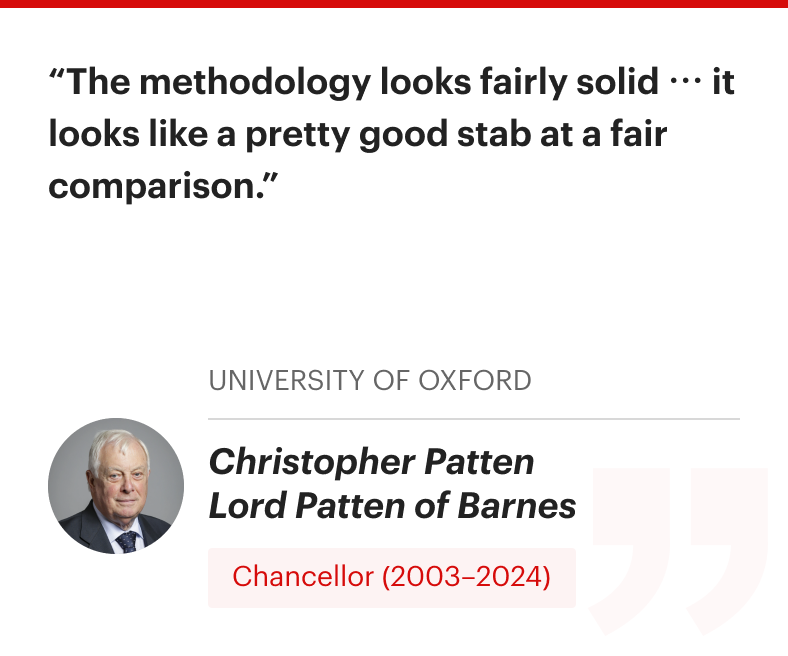
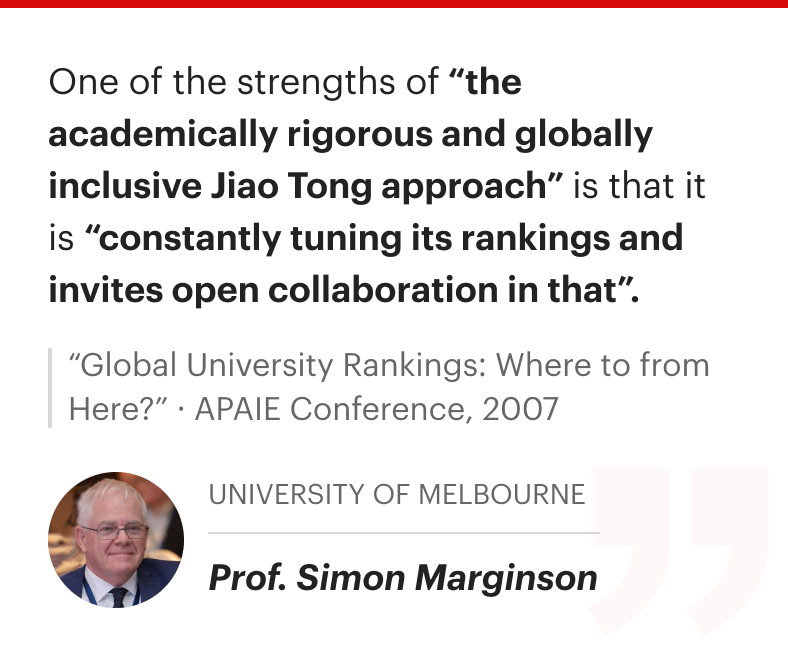
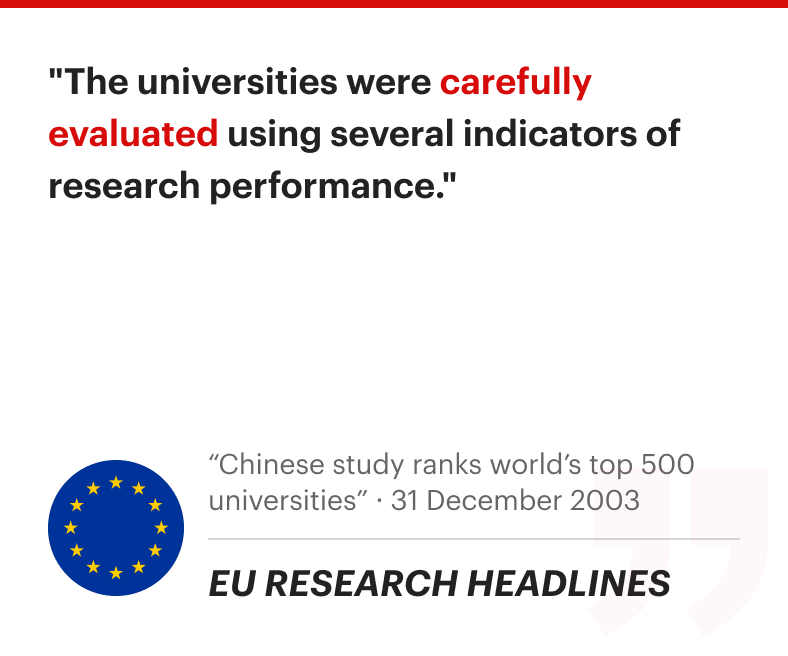
One of the factors for the significant influence of ARWU is that its methodology is scientifically sound, stable and
transparent.
ARWU and its content have been widely cited and employed as a starting point for identifying national strengths and
weaknesses as well as facilitating reform and setting new initiatives. Bill Destler, the President of the Rochester
Institute of Technology, drew reference to ARWU to analyze the comparative advantages that the Western Europe and US
have in terms of intellectual talent and creativity in his publication in the journal
Nature. Martin Enserink referred to ARWU and argued in his paper published in
Science that "France’s poor showing in the Shanghai ranking … helped trigger a
national debate about higher education that resulted in a new law… giving universities more freedom".