
 Chinese
 Log In/Register



Academic Ranking of World Universities(ARWU)
 Download Excel
 151-200
Academic Ranking of World Universities  The Academic Ranking of World Universities (ARWU) was first published in June 2003 by the Center for World-Class Universities (CWCU), Graduate School of Education (formerly the Institute of Higher Education) of Shanghai Jiao Tong University, China, and updated on an annual basis. Since 2009 the Academic Ranking of World Universities (ARWU) has been published and copyrighted by ShanghaiRanking Consultancy. ShanghaiRanking Consultancy is a fully independent organization on higher education intelligence and not legally subordinated to any universities or government agencies. ARWU uses six objective indicators to rank world universities, including the number of alumni and staff winning Nobel Prizes and Fields Medals, number of highly cited researchers selected by Clarivate, number of articles published in journals of Nature and Science, number of articles indexed in Science Citation Index Expanded and Social Sciences Citation Index in the Web of Science, and per capita performance of a university. More than 2500 universities are actually ranked by ARWU every year and the best 1000 are published. (Read full Methodology)
The Academic Ranking of World Universities (ARWU) was first published in June 2003 by the Center for World-Class Universities (CWCU), Graduate School of Education (formerly the Institute of Higher Education) of Shanghai Jiao Tong University, China, and updated on an annual basis. Since 2009 the Academic Ranking of World Universities (ARWU) has been published and copyrighted by ShanghaiRanking Consultancy. ShanghaiRanking Consultancy is a fully independent organization on higher education intelligence and not legally subordinated to any universities or government agencies. ARWU uses six objective indicators to rank world universities, including the number of alumni and staff winning Nobel Prizes and Fields Medals, number of highly cited researchers selected by Clarivate, number of articles published in journals of Nature and Science, number of articles indexed in Science Citation Index Expanded and Social Sciences Citation Index in the Web of Science, and per capita performance of a university. More than 2500 universities are actually ranked by ARWU every year and the best 1000 are published. (Read full Methodology)
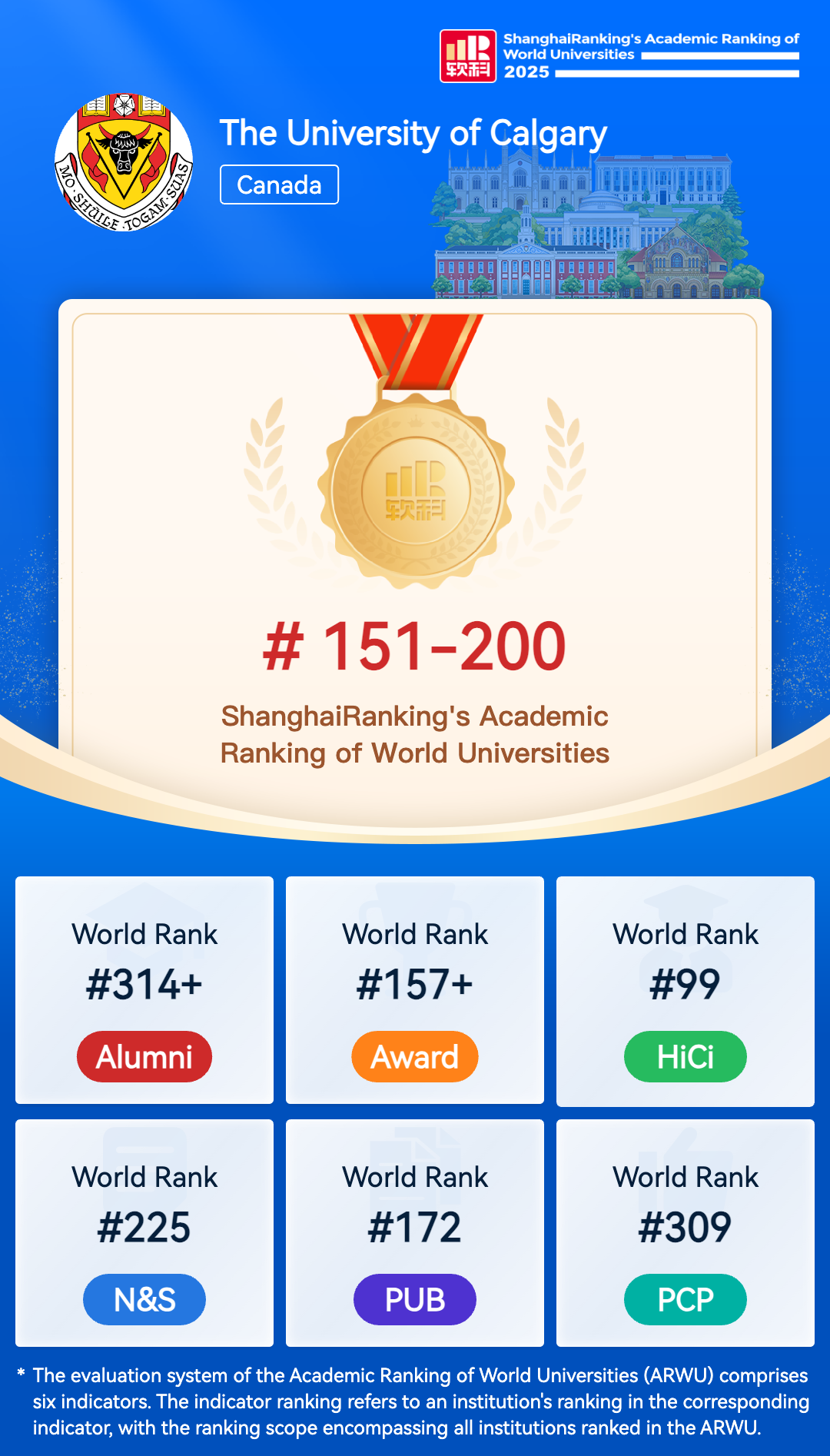
The University of Calgary ranks #151-200 in the 2025 Academic Ranking of World Universities.
Decode Your University's Ranking Data

Download the Official Badge
Total Score
Score on Alumni Number of the alumni of an institution winning Nobel Prizes and Fields Medals. Alumni are defined as those who obtain bachelor's, master's or doctoral degrees from the institution. Different weights are set according to the periods of obtaining degrees. The weight is 100% for alumni obtaining degrees after 2011, 90% for alumni obtaining degrees in 2001-2010, 80% for alumni obtaining degrees in 1991-2000, and so on, and finally 10% for alumni obtaining degrees in 1921-1930. If a person obtains more than one degree from an institution, the institution is considered once only. (Read full Methodology)
Number of the alumni of an institution winning Nobel Prizes and Fields Medals. Alumni are defined as those who obtain bachelor's, master's or doctoral degrees from the institution. Different weights are set according to the periods of obtaining degrees. The weight is 100% for alumni obtaining degrees after 2011, 90% for alumni obtaining degrees in 2001-2010, 80% for alumni obtaining degrees in 1991-2000, and so on, and finally 10% for alumni obtaining degrees in 1921-1930. If a person obtains more than one degree from an institution, the institution is considered once only. (Read full Methodology)0.0
Score on Award Number of the staff of an institution winning Nobel Prizes in Physics, Chemistry, Medicine and Economics and Fields Medal in Mathematics. Staff is defined as those who work at an institution at the time of winning the prize. Different weights are set according to the periods of winning the prizes. The weight is 100% for winners after 2021, 90% for winners in 2011-2020, 80% for winners in 2001-2010, 70% for winners in 1991-2000, and so on, and finally 10% for winners in 1931-1940. If a winner is affiliated with more than one institution, each institution is assigned the reciprocal of the number of institutions. For Nobel prizes, if a prize is shared by more than one person, weights are set for winners according to their proportion of the prize. (Read full Methodology)
Number of the staff of an institution winning Nobel Prizes in Physics, Chemistry, Medicine and Economics and Fields Medal in Mathematics. Staff is defined as those who work at an institution at the time of winning the prize. Different weights are set according to the periods of winning the prizes. The weight is 100% for winners after 2021, 90% for winners in 2011-2020, 80% for winners in 2001-2010, 70% for winners in 1991-2000, and so on, and finally 10% for winners in 1931-1940. If a winner is affiliated with more than one institution, each institution is assigned the reciprocal of the number of institutions. For Nobel prizes, if a prize is shared by more than one person, weights are set for winners according to their proportion of the prize. (Read full Methodology)0.0
Score on HiCi Number of Highly Cited Researchers selected by the Institute for Scientific Information at Clarivate. The Highly Cited Researchers list issued in November 2024 was used for the calculation of HiCi indicator in ARWU 2025. If a Highly Cited Researcher receives recognition in more than one ESI fields, each field is counted separately. Only the primary affiliations of Highly Cited Researchers are considered. (Read full Methodology)
Number of Highly Cited Researchers selected by the Institute for Scientific Information at Clarivate. The Highly Cited Researchers list issued in November 2024 was used for the calculation of HiCi indicator in ARWU 2025. If a Highly Cited Researcher receives recognition in more than one ESI fields, each field is counted separately. Only the primary affiliations of Highly Cited Researchers are considered. (Read full Methodology)24.6
Score on N&S Number of research articles published in Nature and Science between 2020 and 2024. To distinguish the order of author affiliation, a weight of 100% is assigned for corresponding author affiliation, 50% for first author affiliation (second author affiliation if the first author affiliation is the same as corresponding author affiliation), 25% for the next author affiliation, and 10% for other author affiliations. When there are more than one corresponding author addresses, we consider the first corresponding author address as the corresponding author address and consider other corresponding author addresses as first author address, second author address etc. following the order of the author addresses. Only publications of 'Article' type are considered. (Read full Methodology)
Number of research articles published in Nature and Science between 2020 and 2024. To distinguish the order of author affiliation, a weight of 100% is assigned for corresponding author affiliation, 50% for first author affiliation (second author affiliation if the first author affiliation is the same as corresponding author affiliation), 25% for the next author affiliation, and 10% for other author affiliations. When there are more than one corresponding author addresses, we consider the first corresponding author address as the corresponding author address and consider other corresponding author addresses as first author address, second author address etc. following the order of the author addresses. Only publications of 'Article' type are considered. (Read full Methodology)15.3
Score on PUB Number of papers indexed in Science Citation Index-Expanded and Social Science Citation Index (Web of Science) in 2024. Only publications of 'Article' type are considered. When calculating the total number of papers of an institution, a special weight of two was introduced for papers indexed in Social Science Citation Index. (Read full Methodology)
Number of papers indexed in Science Citation Index-Expanded and Social Science Citation Index (Web of Science) in 2024. Only publications of 'Article' type are considered. When calculating the total number of papers of an institution, a special weight of two was introduced for papers indexed in Social Science Citation Index. (Read full Methodology)46.1
Score on PCP Weighted scores of the above five indicators divided by the number of full-time equivalent academic staff. If the number of academic staff for institutions of a country cannot be obtained, the average number of academic staff for world top 1000 universities will be used for all institutions in this country. For ARWU 2025, the numbers of full-time equivalent academic staff are obtained for institutions in USA, UK, China, France, Germany, Canada, Japan, Italy, Australia, Netherlands, Sweden, Switzerland, Belgium, South Korea, Czechia, New Zealand, Saudi Arabia, Spain, Austria, Norway, Poland, Israel etc. (Read full Methodology)
Weighted scores of the above five indicators divided by the number of full-time equivalent academic staff. If the number of academic staff for institutions of a country cannot be obtained, the average number of academic staff for world top 1000 universities will be used for all institutions in this country. For ARWU 2025, the numbers of full-time equivalent academic staff are obtained for institutions in USA, UK, China, France, Germany, Canada, Japan, Italy, Australia, Netherlands, Sweden, Switzerland, Belgium, South Korea, Czechia, New Zealand, Saudi Arabia, Spain, Austria, Norway, Poland, Israel etc. (Read full Methodology)20.8